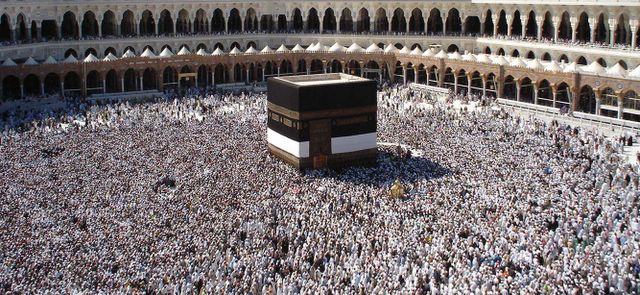
In light of a United Nations population report, Saudi Arabia has enhanced the quota of Pakistani Hajj pilgrims by 19,609 for 2011 – a year in which Islamabad will divide its pilgrims into two separate categories of “Green and White”.
A draft of the new Hajj policy 2011, available with The Express Tribune, shows that the increase in Pakistan’s quota for the annual pilgrimage follows a UN report stating that the country’s population reached 184.8million in 2010.
Following the enhancement, the total number of pilgrims from Pakistan will stand at 179,256 as opposed to 159,547 in 2010.
The most striking part of this new Hajj policy is that the government has decided to introduce two varying accommodation categories for its pilgrims – “Green” and “White” – divided in terms of rent/distance from the Haram Sharif.
Those opting to use the Green category would be required to pay a total of Rs210,047 (for pilgrims belonging to Karachi, Quetta and Sukkur) or Rs222,047 (for those hailing from the rest of the country).
This category will have accommodation within 2,000 metres of the Haram Sharif.
Pilgrims opting for the White category from Karachi, Quetta and Sukkur would pay
Rs200,847 – while those from the rest of Pakistan would pay Rs212,847.
The distance of the accommodation provided under this category will be over 2,000 metres, but will be provided transport facilities.
The government is also making it mandatory for each pilgrim to buy Saudi Riyal 1,000 from the open market before departing for Hajj – an undertaking of which will be submitted with the Hajj application. This new policy might raise the local rates of Saudi Riyal in the open market as a total of 90,000 pilgrims performing Hajj under the government scheme will all be required to buy the amount from the open market.
The new policy also says that any person who has performed Hajj during the last five years shall not be eligible this year. The Religious Ministry is also launching a pilgrim protection scheme under which each Haji would be required to contribute nonrefundable Rs400, which will be collected in Modarabah banks in Pakistan.
In case of death during the pilgrimage, a sum of Rs200,000 will be paid – while for the loss of a limb in an accident Rs50,000, loss of two limbs Rs100,000 and emergency evacuation due to illness Rs50,000.
Earlier, Pakistan had submitted its case to Saudi Arabian authorities to have its pilgrim quota enhanced in the light of the UN population report. In 1987, the ratio was fixed at 1:1,000 Muslim inhabitants of a country.
The criterion for determining total as well as Muslim population of a country has been standardised by Saudi Arabian authorities to be on the basis of UN population statistics. As per UN estimates (state of world population report 2010), the population of Pakistan is 184.8 million out of which 97 percent are Muslim. Pakistan raised the issue with Saudi authorities when a Pakistani delegation visited Saudi Arabia last month.
Other salient features of the new Hajj policy:
(i) This year, there will be no balloting. The method of first come, first served is being introduced. Applications will be invited from April 11 to April 30.
(ii) There shall be two schemes, i.e. government Hajj scheme and through Hajj Group Organisations (HGOs).
(iii) Out of the total allocation, 50 per cent would be allocated to the government Hajj scheme and 50 per cent to private scheme.
(iv) Unsuccessful applicants for Hajj 2010 will be considered approved for Hajj 2011 if they have not withdrawn Hajj dues subject to the condition that they have not applied afresh for Hajj 2011. Dues will be adjusted.
(v) 15 per cent of the total seats under government scheme would be reserved for following categories of applicants: hardships, broken family and substitution cases, pilgrims recommended and fully funded by charitable/reputable organisations such as the Shaikh Rashid bin Said Al Maktoum Hajj Foundation sponsored by UAE, employees of PTC, NTC, PTA, Kahuta Research Laboratories, OGDC, Hamdard Foundation, or those on the recommendation of the ministry of Labour and Manpower.
Published in The Express Tribune, April 6th, 2011.